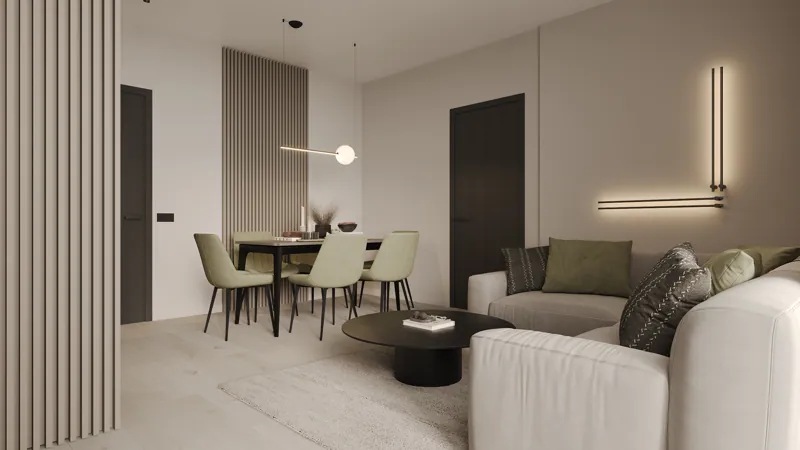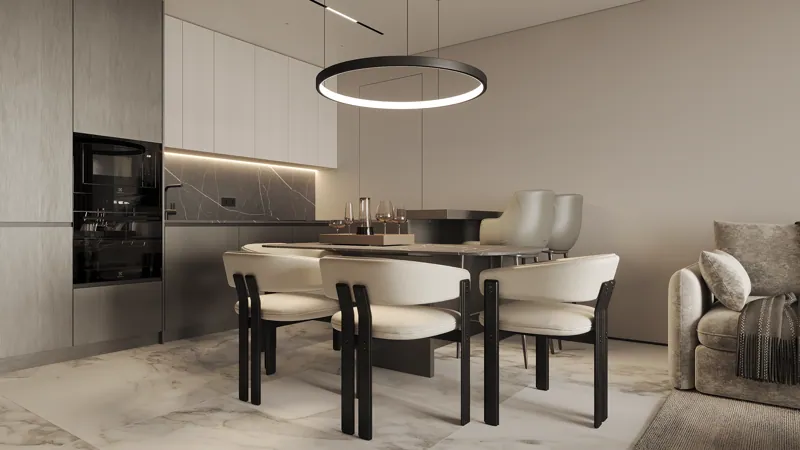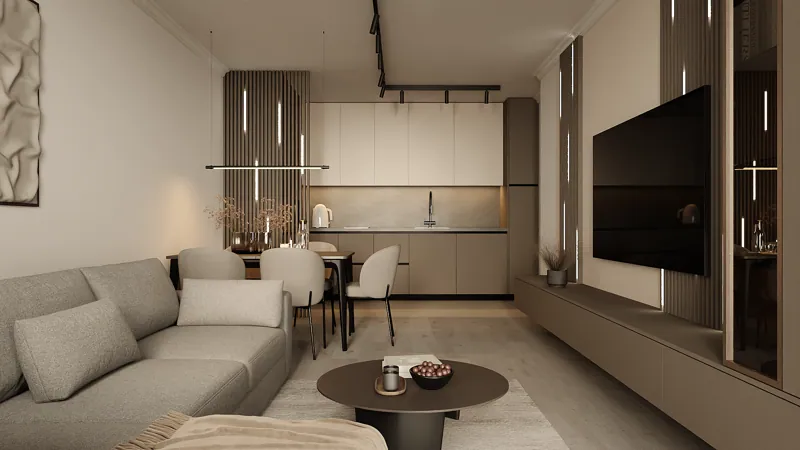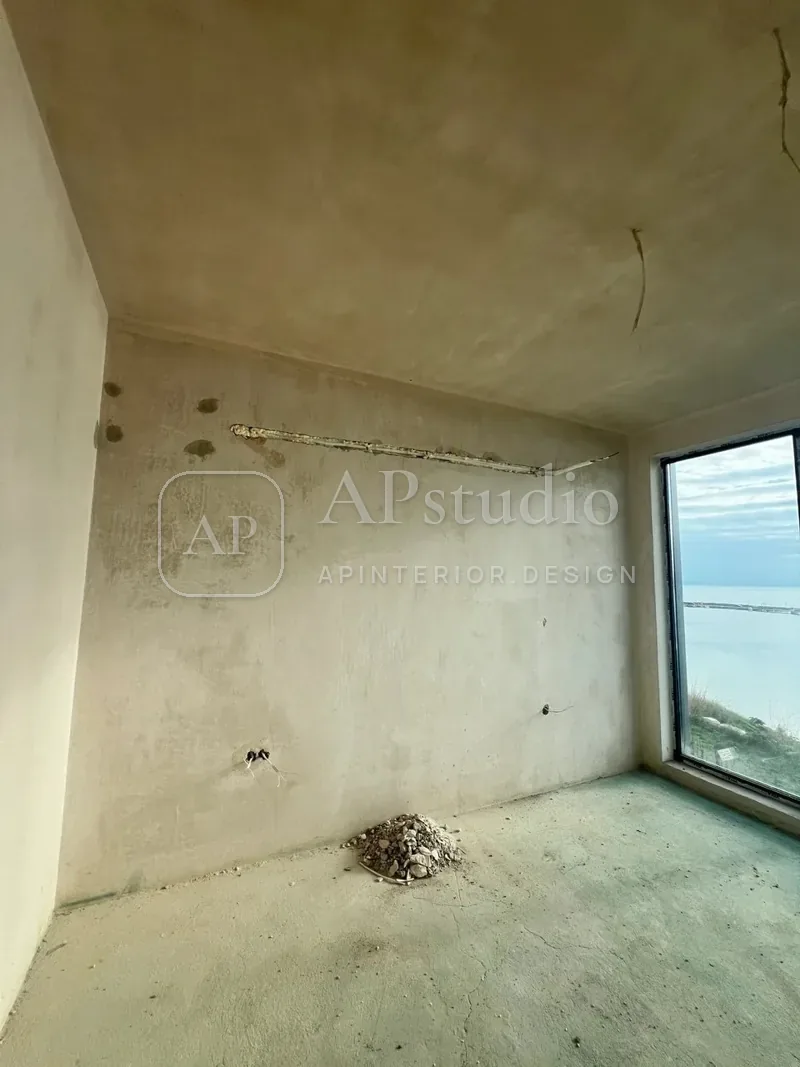

It is a very familiar picture: a beautiful pendant in the middle of the room, and that is it. During the day there is no problem, but in the evening the living room is either as bright as a clinic waiting room or sinks into gloom in the corners. Lighting is the one part of an interior that is almost impossible to add later without dust, because the cables are hidden in the walls and ceiling. That is why we talk about it at the very first stage of the project, before tiles and sofas.
Three layers of light
Good lighting is built from several layers that can be switched on separately. You do not need all of them at once, or in every room, but the more options you have, the more alive the apartment feels.
- Ambient light. This lights the room evenly: recessed or surface-mounted downlights, track systems or that same pendant. You need it when you are cleaning, getting ready or have a lot of guests.
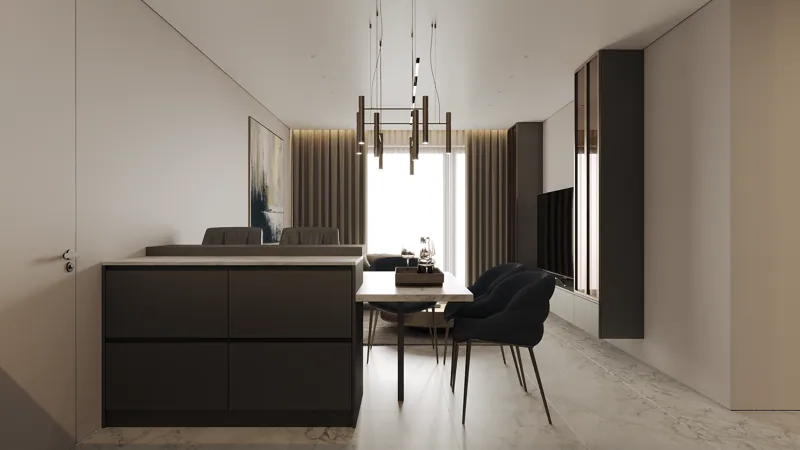
- Task and accent light. Wherever you are doing something: above the kitchen worktop, by the bathroom mirror, next to a reading chair, over the dining table. This also includes directional light on a painting, a niche or a textured wall.
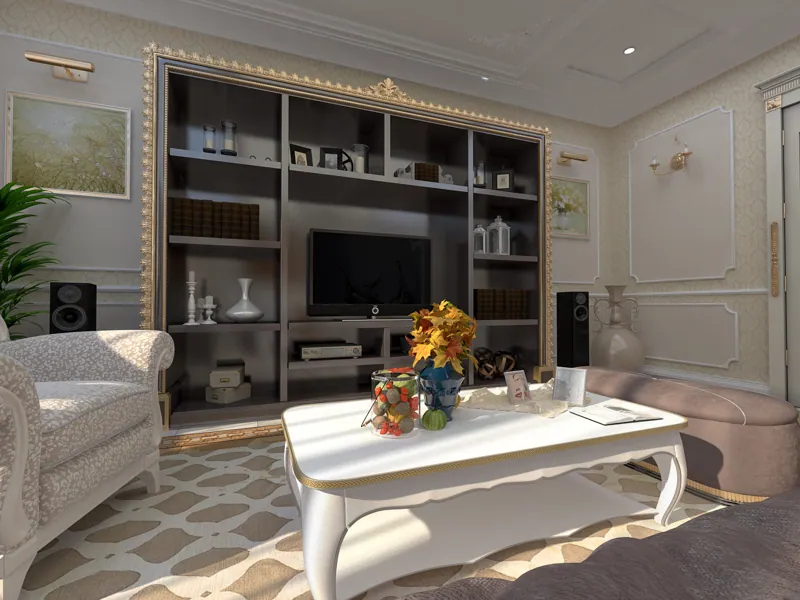
- Decorative light. Shelf and niche lighting, an LED strip under a floating bed or vanity unit, a floor lamp, a table lamp. This is the layer that creates the evening mood.
With all three layers in place, the same room changes at the touch of a button, from practical to cosy.
By the sea there is a particular twist: in summer it stays light until late, and the lights only go on closer to night-time, when what you want is calm rather than brightness. So in holiday apartments we focus on the accent and decorative layers, and keep ambient light for cleaning and getting ready.
Lighting scenes: how you live in the evening
We start not with light fittings but with questions. Where do you have dinner? Do you watch films? Do you read in bed? Do you get up at night? Will you be letting the apartment? Guests need the lights to work intuitively, without instructions stuck to the fridge.
- "Dinner": the pendant over the table and soft kitchen lighting, with the ambient light off.
- "Cinema": only the lighting behind the TV or in niches, so there is no glare on the screen.
- "Night": dim floor-level lighting in the hallway or by the bed with a motion sensor, so you can get to the bathroom without blinding yourself with the overhead light.
- "Leaving": one switch by the front door turns off the whole apartment.
You do not need a smart home for this. In most cases it is enough to split the fittings into the right groups, put the switches where your hand naturally reaches, and add dimmers in the living room and bedroom. Smart controls can be added later, as long as the wiring has been run with some spare capacity from the start.
For a rental apartment we simplify the logic: by the entrance, a switch for the main living room light; by the bed, its own light plus a switch for the ambient light; in the bathroom, the mirror light switches on separately. A guest should be able to work it out within a minute, otherwise the review will say "we couldn't figure out how to switch the lights on".
Warm light and a consistent tone
For living spaces we almost always choose warm light of 2700–3000 K. It is softer and closer to the evening sun. Neutral 4000 K is appropriate where you need to see colours and details accurately: in a walk-in wardrobe, a storeroom, sometimes the kitchen work area. Cold light in a seaside living room, however, turns even the cosiest interior into an office.
The second parameter is colour rendering. Fittings with a CRI (Ra) of 90 or above show wood, fabric and skin naturally. Cheap strips and bulbs often give a greenish or grey cast, and then even expensive finishes look dull.
A typical mistake we see: in one room the spotlights are one tone, the strip another and the pendant a third. Each is fine on its own, but together they look patchy. Keep to one colour temperature within a room.
Sockets and connection points: at design stage
The key thing to remember is that all of this is decided before plastering. Once the walls are levelled and painted, the only way to add a point for a wall light or a strip in a niche is to chase the wall, with dust, repairs to the finish and compromises.
- Connection points for wall lights or pendants on both sides of the bed, and a switch for the ambient light at the headboard.
- A connection point above the dining table, where the table will actually be, not in the centre of the room out of habit.
- Power supplies for LED lighting in an accessible place. They are a consumable part and must never be sealed into a wall.
- Sockets for a floor lamp, a table lamp and mirror lighting.
- Under-cabinet lighting for the kitchen work area.
- On the terrace, outdoor light fittings and moisture-protected sockets. Salty air quickly eats away cheap metal, so this is no place to economise.
In our working drawings, lighting and sockets have their own sheets, with heights, set-out dimensions and switch groups. The electrician works from them rather than by eye, and you do not have to decide at the last minute where to move the bed so that the cable reaches it.
If you are only just planning a renovation, start the conversation about lighting before the one about materials. We will help you think through scenes for your lifestyle or for your guests and build everything into the design. Our interior design project starts from 25 € per m², and you can estimate the cost of the whole renovation with the calculator on our website.
Still have questions?
Tell us about your property and we will get back to you with a preliminary estimate.